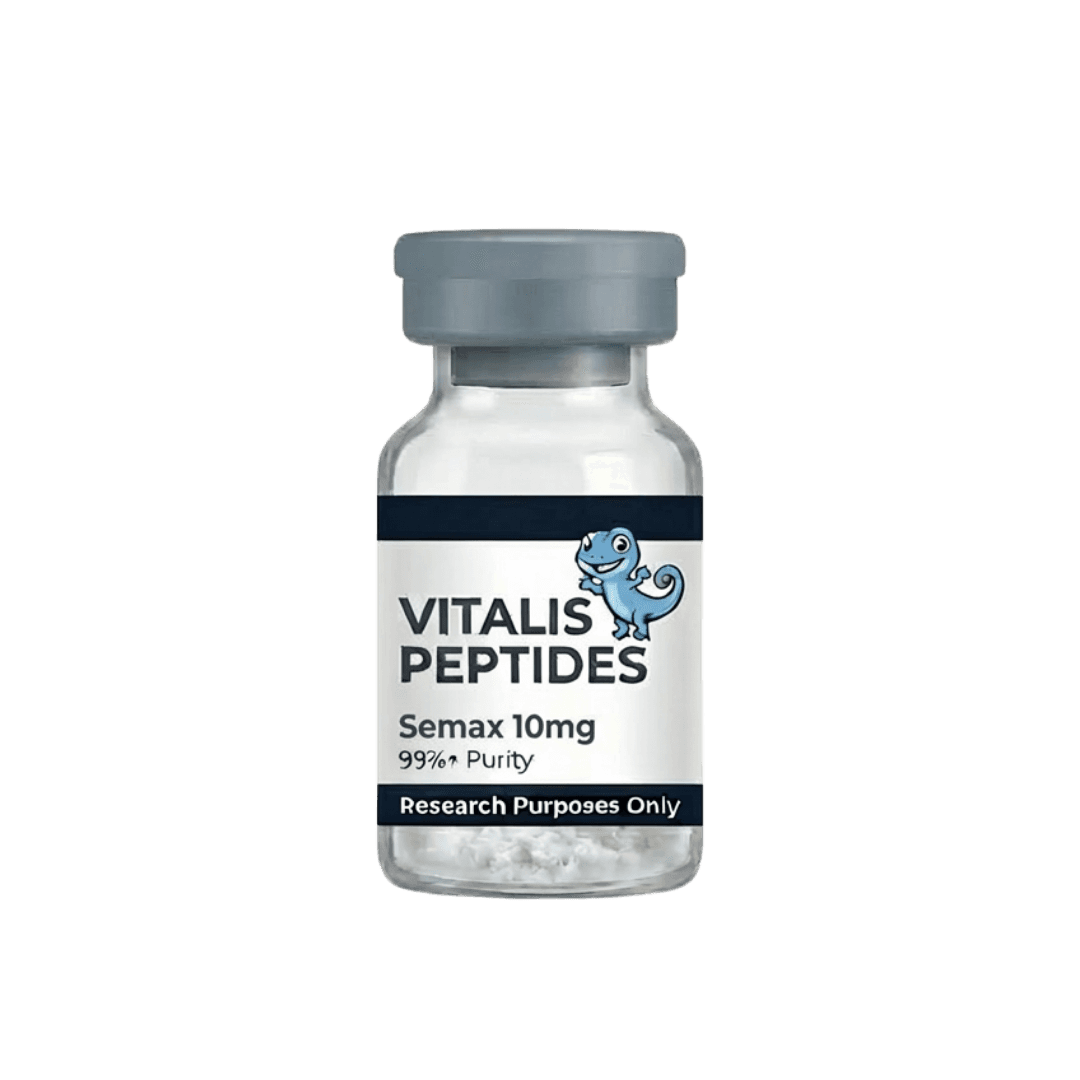
Semax is a synthetic heptapeptide analogue of the ACTH(4-10) fragment, developed at the Institute of Molecular Genetics of the Russian Academy of Sciences. It has been studied for over 30 years for neuroprotective, nootropic, and neurotrophic properties, and is approved in Russia as a nasal spray for conditions including stroke recovery and cognitive enhancement.
Semax is based on the ACTH(4-10) fragment — the portion of adrenocorticotropic hormone that retains neurotrophic activity without adrenal cortex stimulation. The C-terminal Pro-Gly-Pro tripeptide extension enhances metabolic stability and prolongs biological activity. Unlike full-length ACTH, Semax does not stimulate cortisol or corticosteroid production, making it selective for central nervous system effects.
The primary studied mechanism of Semax involves upregulation of brain-derived neurotrophic factor (BDNF) and its receptor TrkB. BDNF is a critical neurotrophin that supports neuronal survival, synaptic plasticity, and long-term potentiation — processes fundamental to learning and memory. Semax has been shown to increase BDNF mRNA expression in hippocampal and cortical neurons in preclinical models.
Additionally, Semax modulates the expression of nerve growth factor (NGF) and neurotrophins NT-3 and NT-4/5. It has demonstrated neuroprotective effects in ischaemia models, reducing infarct size and improving functional recovery after experimental stroke. The mechanism appears to involve inhibition of oxidative stress pathways and modulation of inflammatory cytokine expression in neural tissue. Semax has also been studied for effects on attention, memory consolidation, and cognitive flexibility in both animal models and human studies. In Russia, it is approved as a 1% nasal spray (Semax drops) for conditions including stroke rehabilitation, cognitive dysfunction, and optic nerve disease.
Semax, an analog of ACTH(4-10) with cognitive effects, regulates BDNF and trkB expression in the rat hippocampus
Dolotov OV, Karpenko EA, Inozemtseva LS, et al. · Brain Research (2006)
Demonstrated that Semax significantly increased BDNF and TrkB mRNA expression in rat hippocampus, providing a molecular basis for its cognitive-enhancing effects observed in behavioural studies.
DOI: 10.1016/j.brainres.2005.11.048The peptide semax affects the expression of genes related to the immune and vascular systems in rat brain focal ischemia: genome-wide transcriptional analysis
Medvedeva EV, Dmitrieva VG, Povarova OV, et al. · BMC Genomics (2014)
Genome-wide transcriptional analysis revealing that Semax modulates expression of immune and vascular genes in ischaemic brain tissue, supporting neuroprotective mechanisms beyond simple neurotrophic effects.
DOI: 10.1186/1471-2164-15-228Design and investigation of an ACTH(4-10) analogue lacking D-amino acids and possessing nootropic properties
Ashmarin IP, Nezavibatko VN, Levitskaya NG, et al. · Neuroscience Research Communications (1995)
Original characterisation of Semax as a stable, biologically active ACTH(4-10) analogue, documenting its nootropic properties in animal behavioural models and the rationale for the Pro-Gly-Pro extension.
Synthetic ACTH analogue semax displays nootropic-like activity in humans
Kaplan AY, Kochetova AG, Nezavibathko VN, et al. · Neuroscience Research Communications (1996)
Early human study demonstrating that Semax improved attention and memory performance in healthy volunteers, establishing its nootropic profile in humans.
Semax dissolves readily in bacteriostatic water. Direct solvent along the vial wall and allow full dissolution. Note: the approved Russian form is a nasal spray, but the lyophilised research form is reconstituted for various research administration routes.
Use reconstitution calculatorLyophilised: store at or below 5 °C for up to 12 months. Reconstituted: refrigerate at 2–8 °C and use within 30 days. Protect from light.
No. Semax is derived from the ACTH(4-10) fragment, which retains neurotrophic activity without the adrenal cortex-stimulating properties of full-length ACTH(1-39). Semax does not significantly stimulate cortisol or corticosteroid production at research concentrations.
The C-terminal Pro-Gly-Pro tripeptide was added to the ACTH(4-10) sequence to enhance metabolic stability. Without this modification, the native ACTH(4-10) fragment is rapidly degraded by peptidases. The PGP extension extends the biological half-life while preserving neurotrophic activity.
Semax is approved in Russia as a 0.1% and 1% nasal spray for conditions including stroke recovery, cognitive impairment, and optic nerve disease. It has been used clinically in Russia for over 20 years. It is not approved by the FDA, EMA, or TGA.
Semax has been shown to increase BDNF mRNA expression in hippocampal and cortical neurons. The mechanism appears to involve activation of the TrkB signalling cascade and modulation of transcription factors that regulate BDNF gene expression, though the exact upstream signalling events are still being characterised.
For research and laboratory purposes only. Not for human use. These statements have not been evaluated by the Therapeutic Goods Administration (TGA). This product is not intended to diagnose, treat, cure, or prevent any disease.