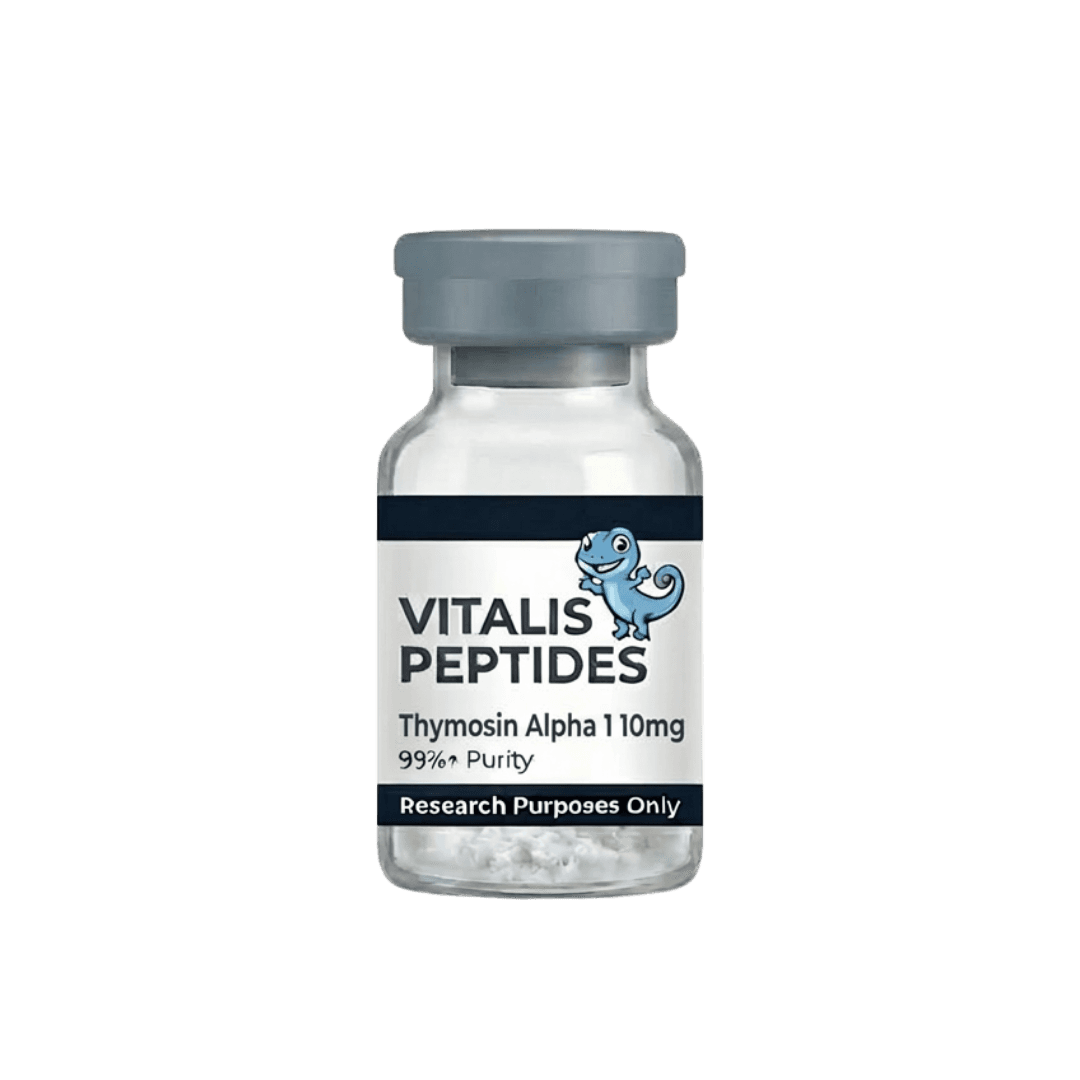
Thymosin Alpha-1 (Tα1) is a naturally occurring 28-amino acid peptide originally isolated from thymic tissue. It is one of the most clinically studied immunomodulatory peptides, with regulatory approval in over 35 countries for hepatitis B and as an immune adjuvant. Over 200 peer-reviewed publications since 2021 document its effects on T-cell maturation, dendritic cell function, and innate immune signalling.
Thymosin Alpha-1 exerts immunomodulatory effects through multiple pathways affecting both innate and adaptive immunity. Its primary studied mechanism involves activation of Toll-like receptors (TLR-2 and TLR-9) on dendritic cells and macrophages, which stimulates the production of pro-inflammatory cytokines including IL-12 and type I interferons. This Toll-like receptor engagement positions Tα1 as a bridge between innate and adaptive immune responses.
In the adaptive immune system, Tα1 promotes T-cell maturation and differentiation. It has been shown to increase expression of the T-cell markers CD4 and CD8, enhance T-cell proliferation in response to antigens, and promote the differentiation of regulatory T cells (Tregs). This dual ability to stimulate effector T-cell function while also promoting regulatory responses is a key characteristic that distinguishes Tα1 from simple immunostimulants — it appears to modulate rather than simply activate the immune system.
Clinically, the synthetic form Zadaxin (thymalfasin) is approved in over 35 countries as an adjunctive treatment for hepatitis B and as a vaccine immune response enhancer. Clinical trials have also investigated Tα1 in hepatitis C, certain cancers (as an immune adjuvant), and sepsis. Recent interest has focused on its potential role in immune restoration, with multiple studies examining Tα1 in the context of immune dysregulation and ageing-related immune decline (immunosenescence).
Thymosin α1: an endogenous regulator of inflammation, immunity, and tolerance
Romani L, Bistoni F, Montagnoli C, et al. · Annals of the New York Academy of Sciences (2007)
Comprehensive review establishing the dual immunomodulatory nature of Tα1 — stimulating effector immune responses while simultaneously promoting tolerance through dendritic cell programming and Treg induction.
DOI: 10.1196/annals.1392.002Thymosin α1 and pertussis vaccine as novel immunotherapeutics
Garaci E, Pica F, Serafino A, et al. · Expert Opinion on Biological Therapy (2015)
Reviewed clinical evidence for Tα1 as an immune adjuvant, including its approved use as a hepatitis B therapy and investigational applications in cancer immunotherapy protocols.
DOI: 10.1517/14712598.2015.1020373Immune modulation with thymosin alpha 1 treatment
King R, Tuthill C. · Vitamins and Hormones (2016)
Detailed the immunomodulatory mechanisms of Tα1, including TLR activation, dendritic cell maturation, and T-cell polarisation, with an overview of clinical trial data across indications.
DOI: 10.1016/bs.vh.2015.11.004Thymosin alpha 1 reduces the mortality of severe COVID-19 by restoration of lymphocytopenia and reversion of exhausted T cells
Liu Y, Pan Y, Hu Z, et al. · Clinical Infectious Diseases (2020)
Retrospective study suggesting that Tα1 treatment restored lymphocyte counts and reduced T-cell exhaustion markers in severe COVID-19 patients, generating renewed research interest in immunosenescence applications.
DOI: 10.1093/cid/ciaa630Direct bacteriostatic water along the vial wall. Tα1 dissolves readily within 1–2 minutes. Do not shake or vortex. The peptide is generally stable in solution.
Use reconstitution calculatorLyophilised: store at or below 5 °C for up to 12 months. Reconstituted: refrigerate at 2–8 °C and use within 30 days. Protect from light.
Yes. The synthetic form thymalfasin (marketed as Zadaxin) is approved in over 35 countries for hepatitis B treatment and as an immune adjuvant. It is not FDA-approved in the United States, but has been the subject of multiple clinical trials in the US and Europe.
Tα1 is described as an immunomodulator rather than an immunostimulant because it can both activate effector immune responses (via TLR activation and T-cell proliferation) and promote immune tolerance (via dendritic cell programming and regulatory T-cell induction). This bidirectional activity is a distinguishing feature.
Tα1 was originally isolated from bovine thymus tissue by Allan Goldstein in the 1970s. The thymus is the primary organ for T-cell maturation, and Tα1 appears to replicate some thymic functions by promoting T-cell differentiation and maturation outside of the thymus.
Interest surged during and after the COVID-19 pandemic, with studies investigating Tα1 for lymphocyte restoration in severe viral infections. Additionally, growing research into immunosenescence (age-related immune decline) has positioned Tα1 as a compound of interest in longevity and immune-ageing research.
For research and laboratory purposes only. Not for human use. These statements have not been evaluated by the Therapeutic Goods Administration (TGA). This product is not intended to diagnose, treat, cure, or prevent any disease.