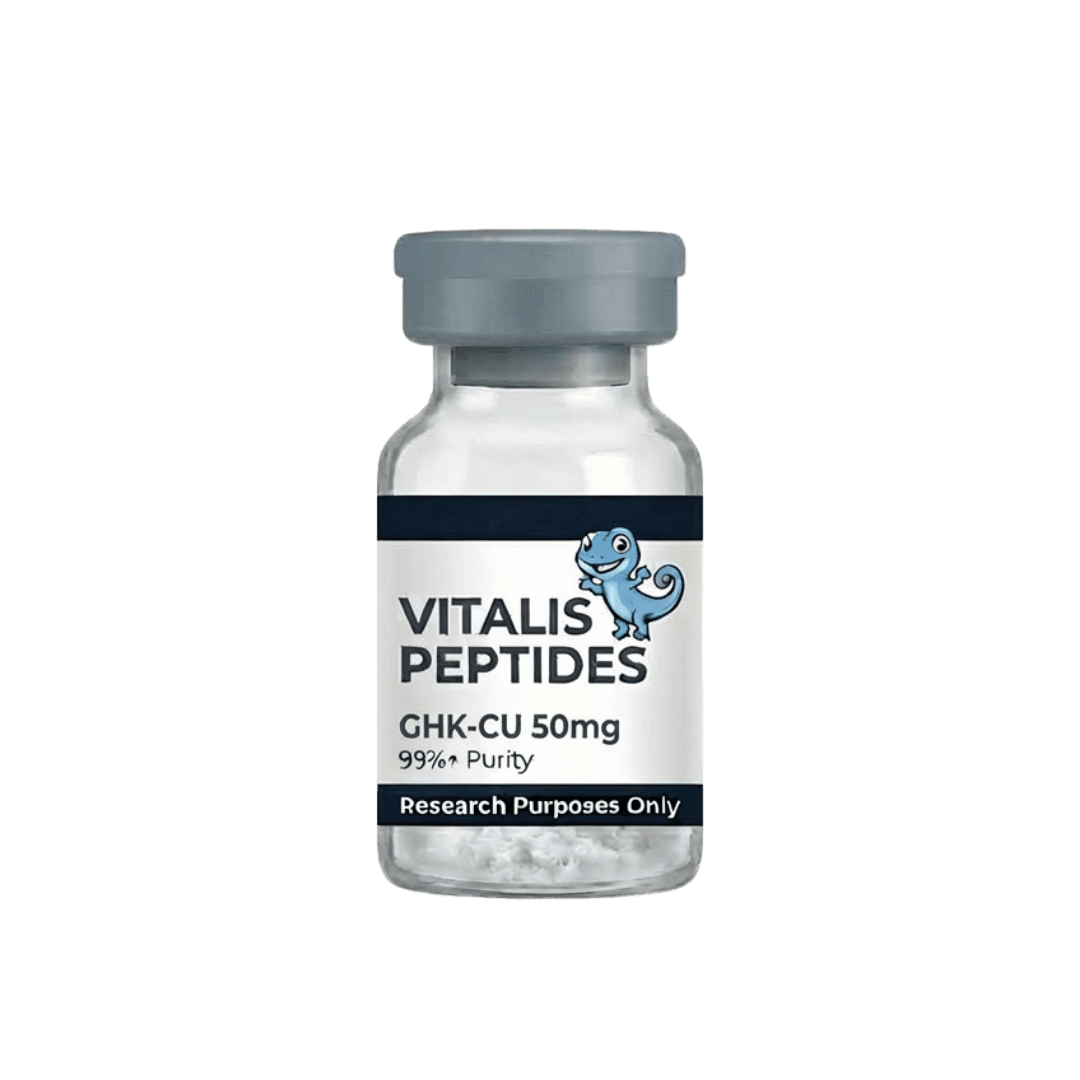
GHK-Cu (glycyl-L-histidyl-L-lysine copper complex) is a naturally occurring copper-binding tripeptide found in human plasma, saliva, and urine. First identified by Loren Pickart in the 1970s, GHK-Cu has been shown to modulate the expression of over 4,000 genes in preclinical models, with particular significance in tissue remodelling, wound healing, and anti-ageing research.
GHK-Cu exerts its biological effects through a dual mechanism: the copper ion delivery and the peptide sequence itself. The copper (II) ion bound to GHK is essential for the activity of numerous metalloenzymes including lysyl oxidase (required for collagen and elastin crosslinking), superoxide dismutase (antioxidant defence), and cytochrome c oxidase (mitochondrial electron transport). By serving as a copper delivery vehicle, GHK-Cu supports the enzymatic machinery of tissue remodelling.
Beyond copper transport, the GHK peptide sequence has been shown to modulate gene expression on a remarkable scale. A landmark 2012 study by Pickart et al., using the Broad Institute's Connectivity Map, demonstrated that GHK altered the expression of 4,048 human genes — approximately 6% of the genome. Upregulated pathways included collagen synthesis, extracellular matrix production, growth factor expression, and anti-inflammatory signalling. Downregulated pathways included pro-inflammatory mediators, pro-fibrotic genes, and genes associated with tissue destruction.
In wound healing models, GHK-Cu has been shown to stimulate fibroblast and endothelial cell proliferation, promote angiogenesis, and increase glycosaminoglycan synthesis. It also upregulates transforming growth factor beta (TGF-β) and VEGF expression. In skin ageing research, GHK-Cu has been studied for its effects on collagen type I, collagen type III, and elastin production, as well as its ability to increase dermal thickness and improve skin mechanical properties. Circulating GHK-Cu levels decline with age (from ~200 ng/mL at age 20 to ~80 ng/mL at age 60), which has generated interest in supplementation research within the ageing field.
GHK peptide as a natural modulator of multiple cellular pathways in skin regeneration
Pickart L, Vasquez-Soltero JM, Margolina A. · BioMed Research International (2015)
Comprehensive review of GHK-Cu's effects on skin regeneration, covering gene expression modulation, collagen synthesis, antioxidant activity, and anti-inflammatory mechanisms.
DOI: 10.1155/2015/648108The human tripeptide GHK-Cu in prevention of oxidative stress and degenerative conditions of aging: implications for cognitive health
Pickart L, Vasquez-Soltero JM, Margolina A. · Oxidative Medicine and Cellular Longevity (2012)
Described the Connectivity Map analysis revealing that GHK modulates expression of 4,048 human genes, with particular relevance to oxidative stress and age-related degenerative pathways.
DOI: 10.1155/2012/324832A therapeutic approach for diabetic wound healing using biotinylated GHK incorporated collagen matrices
Arul V, Kartha R, Jayakumar R. · Life Sciences (2007)
Demonstrated that GHK incorporated into collagen matrices accelerated wound healing in diabetic rat models, with enhanced collagen deposition and angiogenesis at wound sites.
DOI: 10.1016/j.lfs.2006.09.018The effect of topical tripeptide-copper complex on healing of ischemic open wounds
Canapp SO Jr, Farese JP, Schultz GS, et al. · Veterinary Surgery (2003)
In vivo veterinary study showing that topical GHK-Cu application improved healing of ischaemic wounds, with increased granulation tissue formation and epithelialisation.
DOI: 10.1053/jvet.2003.50019GHK-Cu solution has a characteristic blue-green tint due to the copper ion — this is normal and expected. Direct bacteriostatic water along the vial wall and allow full dissolution. Do not shake.
Use reconstitution calculatorLyophilised: store at or below 5 °C for up to 12 months. Reconstituted: refrigerate at 2–8 °C and use within 30 days. The copper complex is generally stable but should be protected from strong light.
The blue-green colour is due to the copper (II) ion complexed with the GHK tripeptide. This is normal and expected — it is the same characteristic colour seen in all copper-containing solutions. A colourless solution would indicate the copper has dissociated.
Analysis using the Broad Institute's Connectivity Map revealed that GHK modulates the expression of 4,048 human genes — approximately 6% of the genome. This includes upregulation of collagen synthesis, growth factors, and antioxidant genes, and downregulation of pro-inflammatory and tissue-destructive genes.
Yes. Circulating GHK-Cu concentrations decline significantly with age, from approximately 200 ng/mL in plasma at age 20 to approximately 80 ng/mL at age 60. This age-related decline has generated research interest in exogenous GHK-Cu supplementation.
Yes. GHK-Cu has been studied in both injectable and topical applications. Topical formulations are common in dermatological and cosmetic research, while injectable reconstitution is used for systemic research applications. The copper peptide has demonstrated activity via both routes.
For research and laboratory purposes only. Not for human use. These statements have not been evaluated by the Therapeutic Goods Administration (TGA). This product is not intended to diagnose, treat, cure, or prevent any disease.