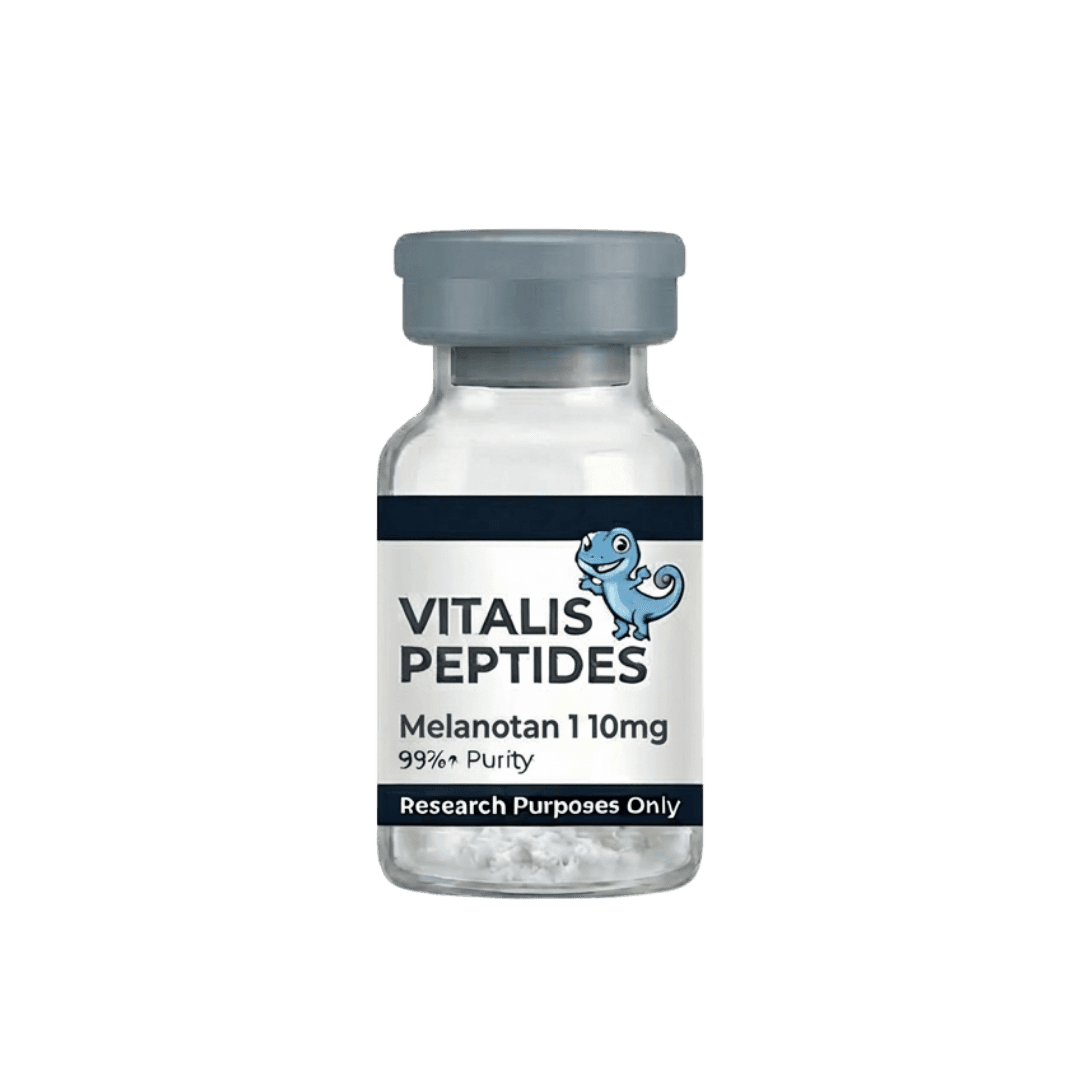
Melanotan I (also known as afamelanotide) is a synthetic linear analogue of alpha-melanocyte-stimulating hormone (α-MSH). It acts primarily on the melanocortin 1 receptor (MC1R) to stimulate melanogenesis. The pharmaceutical form afamelanotide (Scenesse) has received regulatory approval in the EU and US for erythropoietic protoporphyria (EPP).
Melanotan I is a potent and relatively selective agonist of the melanocortin 1 receptor (MC1R), the primary receptor responsible for melanogenesis in the skin. Upon binding MC1R on melanocytes, it activates adenylyl cyclase, increasing intracellular cAMP, which activates protein kinase A (PKA). PKA phosphorylates CREB (cAMP response element-binding protein), which transcriptionally activates MITF (microphthalmia-associated transcription factor) — the master regulator of melanocyte development and melanin synthesis.
MITF upregulation leads to increased expression of melanogenic enzymes: tyrosinase (the rate-limiting enzyme), tyrosinase-related protein 1 (TRP-1), and tyrosinase-related protein 2 (TRP-2/DCT). This enzymatic cascade converts tyrosine through DOPA and dopaquinone to eumelanin, the dark brown-black pigment. The norleucine substitution at position 4 and D-phenylalanine at position 7 in Melanotan I confer resistance to enzymatic degradation and increased receptor binding affinity compared to native α-MSH.
Melanotan I has a more selective MC1R profile compared to Melanotan II, which shows broader melanocortin receptor activity including MC3R, MC4R, and MC5R. This selectivity translates to a more focused melanogenic response with fewer off-target effects in preclinical models. The pharmaceutical form afamelanotide (Scenesse) was approved by the EMA in 2014 and the FDA in 2019 as an implant for adult patients with erythropoietic protoporphyria, where increased melanin provides photoprotection against phototoxic reactions.
Evaluation of melanotan-I, a superpotent cyclic melanotropic peptide in a pilot phase I clinical study
Dorr RT, Lines R, Levine N, et al. · Life Sciences (1996)
First Phase I clinical study of Melanotan I demonstrating dose-dependent increases in skin melanin density in human subjects, establishing proof-of-concept for synthetic melanocortin agonists.
DOI: 10.1016/0024-3205(96)00191-3α-Melanotropin: the minimal active sequence in the frog skin bioassay
Hruby VJ, Wilkes BC, Hadley ME, et al. · Journal of Medicinal Chemistry (1987)
Foundational medicinal chemistry study identifying the minimal active sequence and key structural modifications that led to the development of Melanotan I and related melanocortin agonists.
DOI: 10.1021/jm00397a007Afamelanotide for erythropoietic protoporphyria
Langendonk JG, Balwani M, Anderson KE, et al. · New England Journal of Medicine (2015)
Pivotal Phase III trial demonstrating that afamelanotide (Melanotan I implant) significantly increased pain-free time in sunlight for EPP patients, leading to FDA and EMA approval.
DOI: 10.1056/NEJMoa1411481Melanocortin receptor ligands: new horizons for skin biology and clinical dermatology
Böhm M, Luger TA, Tobin DJ, García-Borrón JC. · Journal of Investigative Dermatology (2006)
Comprehensive review of melanocortin receptor biology in skin, covering MC1R signalling, melanogenesis regulation, and the therapeutic potential of melanocortin agonists.
DOI: 10.1038/sj.jid.5700484Direct bacteriostatic water along the vial wall. Allow full dissolution without shaking. Melanotan I is light-sensitive — reconstitute and handle in subdued lighting where possible.
Use reconstitution calculatorLyophilised: store at or below 5 °C for up to 12 months. Light-sensitive — protect from direct light. Reconstituted: refrigerate at 2–8 °C and use within 30 days.
They are the same compound. Afamelanotide is the International Nonproprietary Name (INN) for Melanotan I, and Scenesse is the brand name for the subcutaneous implant form approved for erythropoietic protoporphyria. The research-grade lyophilised form is the same peptide sequence.
Melanotan I is relatively selective for MC1R (the melanogenesis receptor), while Melanotan II has broader activity across MC1R, MC3R, MC4R, and MC5R. This broader receptor profile is why Melanotan II has been studied for additional effects including appetite and sexual function pathways.
Yes. As afamelanotide (Scenesse), it was approved by the EMA in 2014 and the FDA in 2019 for the prevention of phototoxicity in adult patients with erythropoietic protoporphyria. It is delivered as a subcutaneous implant that slowly releases the peptide over approximately 60 days.
For research and laboratory purposes only. Not for human use. These statements have not been evaluated by the Therapeutic Goods Administration (TGA). This product is not intended to diagnose, treat, cure, or prevent any disease.