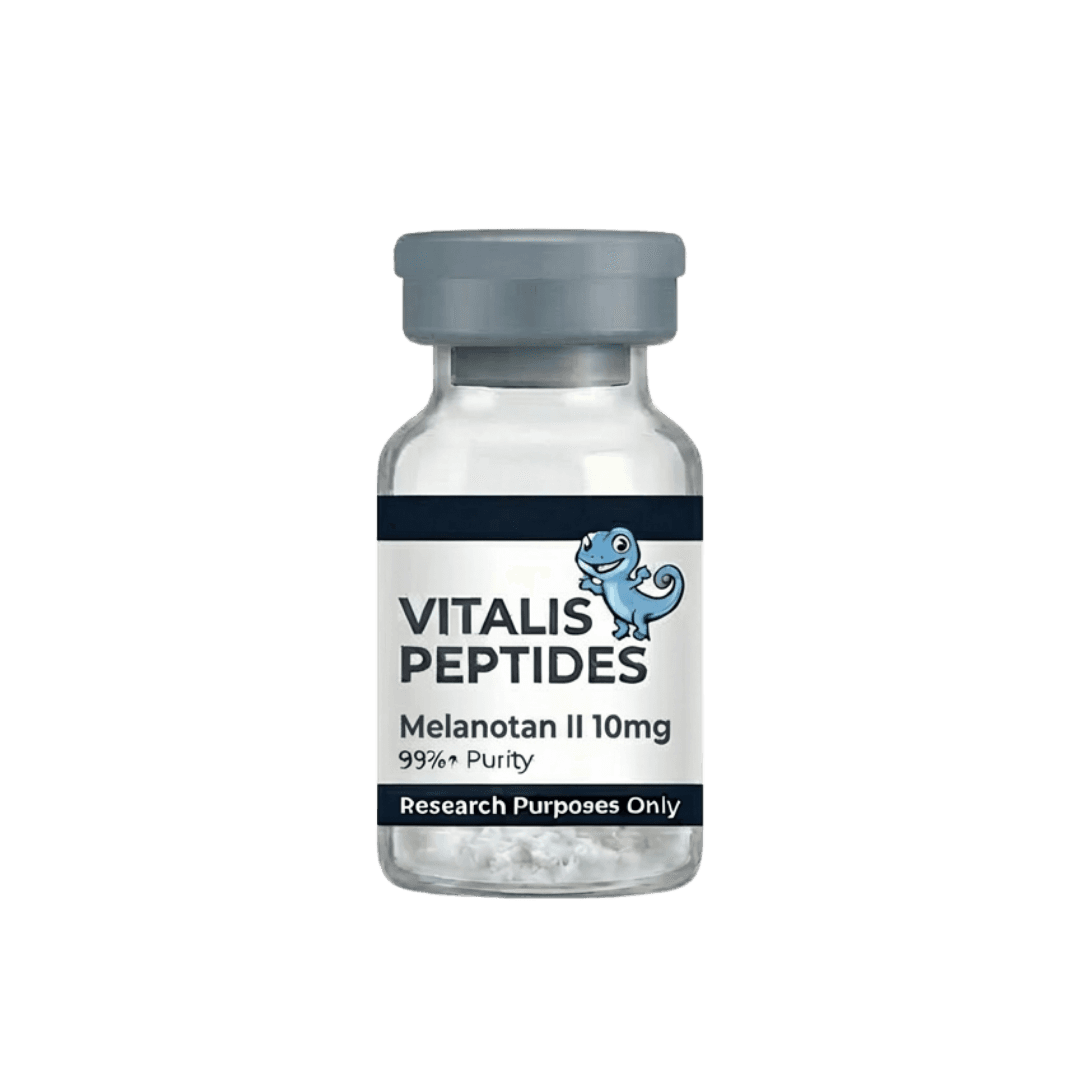
Melanotan II is a synthetic cyclic analogue of alpha-melanocyte-stimulating hormone (α-MSH) with activity across multiple melanocortin receptor subtypes. Unlike the more selective Melanotan I, it engages MC1R, MC3R, MC4R, and MC5R, which has made it a research tool for studying melanogenesis, appetite regulation, and sexual function pathways.
Melanotan II is a non-selective melanocortin receptor agonist, activating MC1R, MC3R, MC4R, and MC5R with varying affinities. Its cyclic structure provides greater metabolic stability and potency compared to linear α-MSH analogues. This multi-receptor activity underlies its diverse pharmacological profile.
At MC1R on melanocytes, Melanotan II activates the cAMP/PKA/CREB/MITF cascade, stimulating eumelanin production via upregulation of tyrosinase and related enzymes — the same pathway as Melanotan I. The pigmentation response is well-documented in both preclinical models and human observational studies.
At MC4R in the hypothalamus, Melanotan II modulates appetite and energy homeostasis pathways. MC4R activation is associated with appetite suppression and increased energy expenditure — the MC4R signalling pathway is one of the best-validated targets in obesity genetics. Additionally, MC4R activation in the paraventricular nucleus and spinal cord has been associated with pro-erectile and sexual arousal effects. This MC4R-mediated sexual function activity led to the development of bremelanotide (PT-141), an FDA-approved MC4R agonist derived from the Melanotan II pharmacophore.
MC3R activation by Melanotan II may contribute to energy homeostasis and immune function modulation, while MC5R activity is associated with sebaceous gland function and exocrine secretion. The broader receptor promiscuity of Melanotan II compared to Melanotan I means it activates a wider range of melanocortin-mediated physiological responses.
Evaluation of melanotan-II, a superpotent cyclic melanotropic peptide in a pilot phase I clinical study
Dorr RT, Lines R, Levine N, et al. · Life Sciences (1996)
Phase I study demonstrating dose-dependent tanning responses and documenting the side-effect profile of Melanotan II in human volunteers, including nausea and facial flushing at higher doses.
DOI: 10.1016/0024-3205(96)00191-3Synthetic melanotropic peptide initiates erections in men with psychogenic erectile dysfunction: double-blind, placebo controlled crossover study
Wessells H, Fuciarelli K, Hansen J, et al. · Journal of Urology (1998)
Demonstrated that Melanotan II initiated erectile responses in men with psychogenic erectile dysfunction, establishing MC4R-mediated pro-erectile activity and leading to the development of bremelanotide (PT-141).
DOI: 10.1016/S0022-5347(01)62916-XMelanocortin peptide therapeutics: historical milestones, clinical studies and commercialization
Hadley ME, Dorr RT. · Peptides (2006)
Historical review by two of the scientists who developed Melanotan II, covering the research journey from university laboratory to clinical applications of melanocortin peptides.
DOI: 10.1016/j.peptides.2005.01.029Exploring the stereostructural requirements of peptide ligands for the melanocortin receptors
Hruby VJ, Cai M, Grieco P, et al. · Annals of the New York Academy of Sciences (2003)
Structure-activity relationship study detailing how the cyclic structure and specific stereochemistry of Melanotan II confer its potency and multi-receptor melanocortin activity.
DOI: 10.1111/j.1749-6632.2003.tb03180.xDirect bacteriostatic water along the vial wall and allow full dissolution. Melanotan II is light-sensitive — reconstitute and handle in subdued lighting. Do not shake.
Use reconstitution calculatorLyophilised: store at or below 5 °C for up to 12 months. Light-sensitive — protect from direct light. Reconstituted: refrigerate at 2–8 °C and use within 30 days.
Melanotan II is a cyclic heptapeptide with broad activity across MC1R, MC3R, MC4R, and MC5R, while Melanotan I is a linear tridecapeptide relatively selective for MC1R. This broader receptor profile means Melanotan II has been studied for additional effects beyond pigmentation, including appetite and sexual function pathways.
Bremelanotide (PT-141, marketed as Vyleesi) was derived from the Melanotan II pharmacophore. It is an FDA-approved MC4R agonist for hypoactive sexual desire disorder in premenopausal women. The pro-erectile effects of Melanotan II observed in early clinical studies led directly to bremelanotide's development.
Melanotan II's activity at MC3R, MC4R, and MC5R (in addition to MC1R) can produce effects beyond pigmentation, including nausea, facial flushing, appetite changes, and sexual arousal. These are direct consequences of multi-receptor melanocortin activation and are generally dose-dependent.
The cyclisation of Melanotan II (through a lactam bridge between Asp and Lys residues) confers enhanced metabolic stability, increased receptor binding affinity, and broader melanocortin receptor activity compared to linear analogues. It also gives the molecule a more constrained conformation that favours multi-receptor engagement.
For research and laboratory purposes only. Not for human use. These statements have not been evaluated by the Therapeutic Goods Administration (TGA). This product is not intended to diagnose, treat, cure, or prevent any disease.