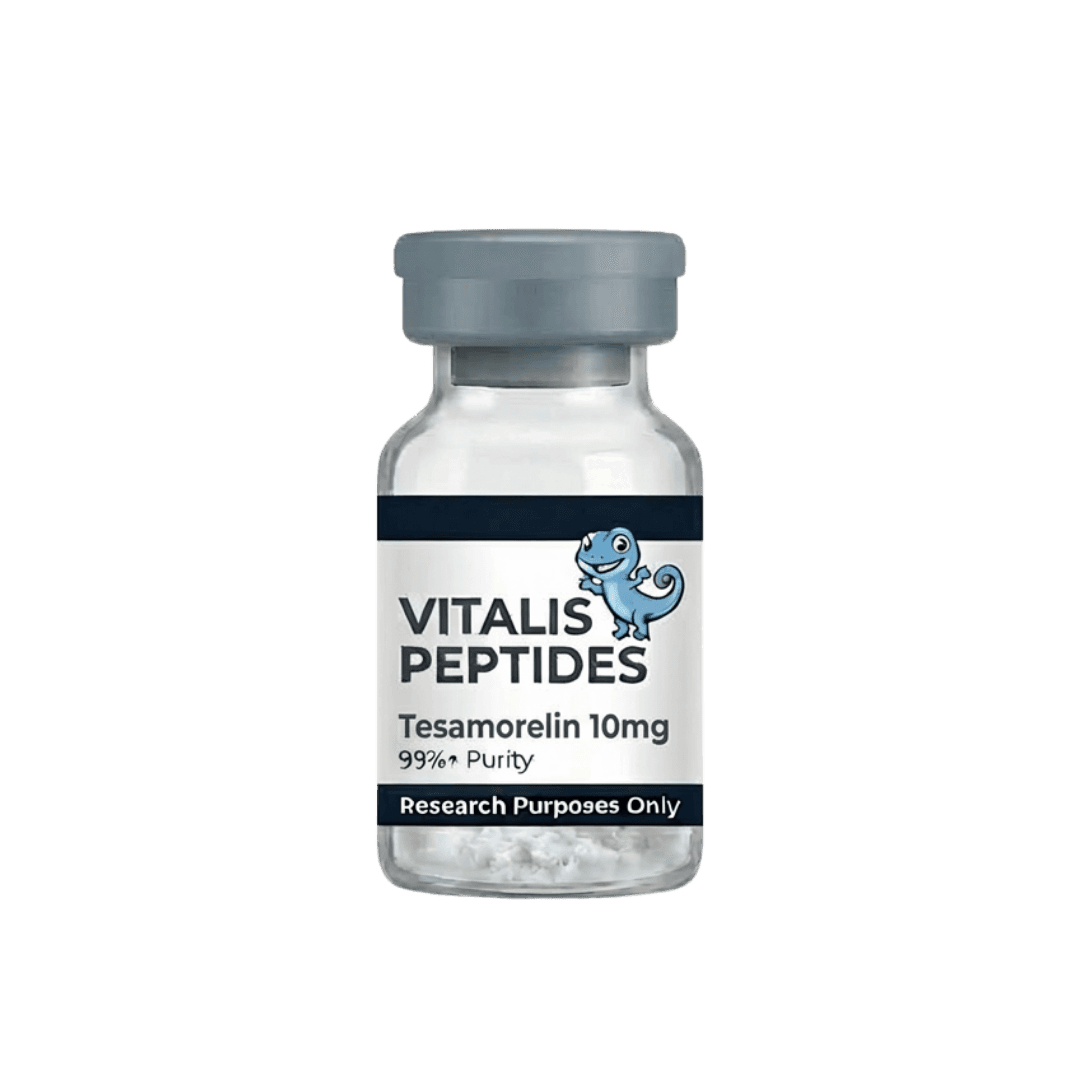
Tesamorelin is a synthetic analogue of human growth hormone-releasing hormone (GHRH) with a trans-3-hexenoic acid modification. It is one of the most clinically validated GH-releasing peptides, with FDA approval (as Egrifta) for HIV-associated lipodystrophy, and is actively researched for broader metabolic and body composition applications.
Tesamorelin binds to the GHRH receptor (GHRH-R) on anterior pituitary somatotroph cells with similar affinity to endogenous GHRH(1-44). Receptor activation stimulates adenylyl cyclase, increasing intracellular cAMP, which activates protein kinase A (PKA) and subsequent GH gene transcription and secretion. The trans-3-hexenoic acid modification at the N-terminus confers enhanced stability against enzymatic degradation without altering receptor binding specificity.
The primary clinical application of tesamorelin has been the reduction of visceral adipose tissue (VAT) in HIV-associated lipodystrophy. Mechanistically, GH stimulation by tesamorelin increases lipolysis in visceral fat depots through hormone-sensitive lipase activation, while simultaneously promoting hepatic IGF-1 production. Clinical trials have demonstrated 15-18% reductions in trunk fat without significant changes in subcutaneous adipose tissue, suggesting preferential visceral fat mobilisation.
More recently, tesamorelin has been investigated for its effects on liver fat reduction in non-alcoholic fatty liver disease (NAFLD). The LIVELY trial demonstrated significant hepatic fat reduction in HIV patients with NAFLD. Its well-characterised safety profile from FDA approval makes tesamorelin a benchmark compound for GH axis research, providing a validated comparator for newer secretagogues.
Metabolic effects of a growth hormone-releasing factor in patients with HIV
Falutz J, Allas S, Blot K, et al. · New England Journal of Medicine (2007)
Pivotal trial demonstrating that tesamorelin significantly reduced visceral adipose tissue in HIV-associated lipodystrophy patients, forming the basis for FDA approval.
DOI: 10.1056/NEJMoa072375Effect of tesamorelin on visceral fat and liver fat in HIV-infected patients with abdominal fat accumulation: a randomized clinical trial
Stanley TL, Feldpausch MN, Oh J, et al. · JAMA (2014)
Demonstrated that tesamorelin reduced both visceral and hepatic fat in HIV patients with abdominal adiposity, expanding the research scope beyond simple VAT reduction.
DOI: 10.1001/jama.2014.8334Effects of tesamorelin on non-alcoholic fatty liver disease in HIV: a randomised, double-blind, multicentre trial
Stanley TL, Fourman LT, Feldpausch MN, et al. · The Lancet HIV (2019)
The LIVELY trial showed significant hepatic fat reduction with tesamorelin in HIV patients with NAFLD, with improvements in hepatic steatosis markers.
DOI: 10.1016/S2352-3018(19)30338-8Tesamorelin: a review of its use in the management of HIV-associated lipodystrophy
Dhillon S. · Drugs (2011)
Comprehensive pharmacological review covering tesamorelin's mechanism, clinical efficacy, safety profile, and its position among GH-releasing compounds.
DOI: 10.2165/11207570-000000000-00000Direct bacteriostatic water gently against the vial wall. Tesamorelin lyophilised powder should dissolve within 1–2 minutes — do not shake. Reconstituted solution should appear clear and colourless.
Use reconstitution calculatorLyophilised: store at or below 5 °C for up to 12 months. Reconstituted: refrigerate at 2–8 °C and use within 30 days. Protect from light.
Tesamorelin (marketed as Egrifta) received FDA approval in 2010 for HIV-associated lipodystrophy, making it one of the most clinically validated GH-releasing peptides. Multiple randomised controlled trials have demonstrated its efficacy for visceral fat reduction.
Both are GHRH analogues that act on the same receptor. Tesamorelin is a modified full-length GHRH(1-44) analogue with a trans-3-hexenoic acid modification, while CJC-1295 (no DAC) is a truncated GHRH(1-29) analogue with amino acid substitutions. Tesamorelin has extensive clinical trial data; CJC-1295 has more limited clinical evidence.
The LIVELY trial (Stanley et al., Lancet HIV 2019) was a randomised, double-blind, multicentre study demonstrating that tesamorelin significantly reduced hepatic fat content in HIV patients with non-alcoholic fatty liver disease. This expanded the research scope of tesamorelin beyond visceral fat to liver fat metabolism.
For research and laboratory purposes only. Not for human use. These statements have not been evaluated by the Therapeutic Goods Administration (TGA). This product is not intended to diagnose, treat, cure, or prevent any disease.