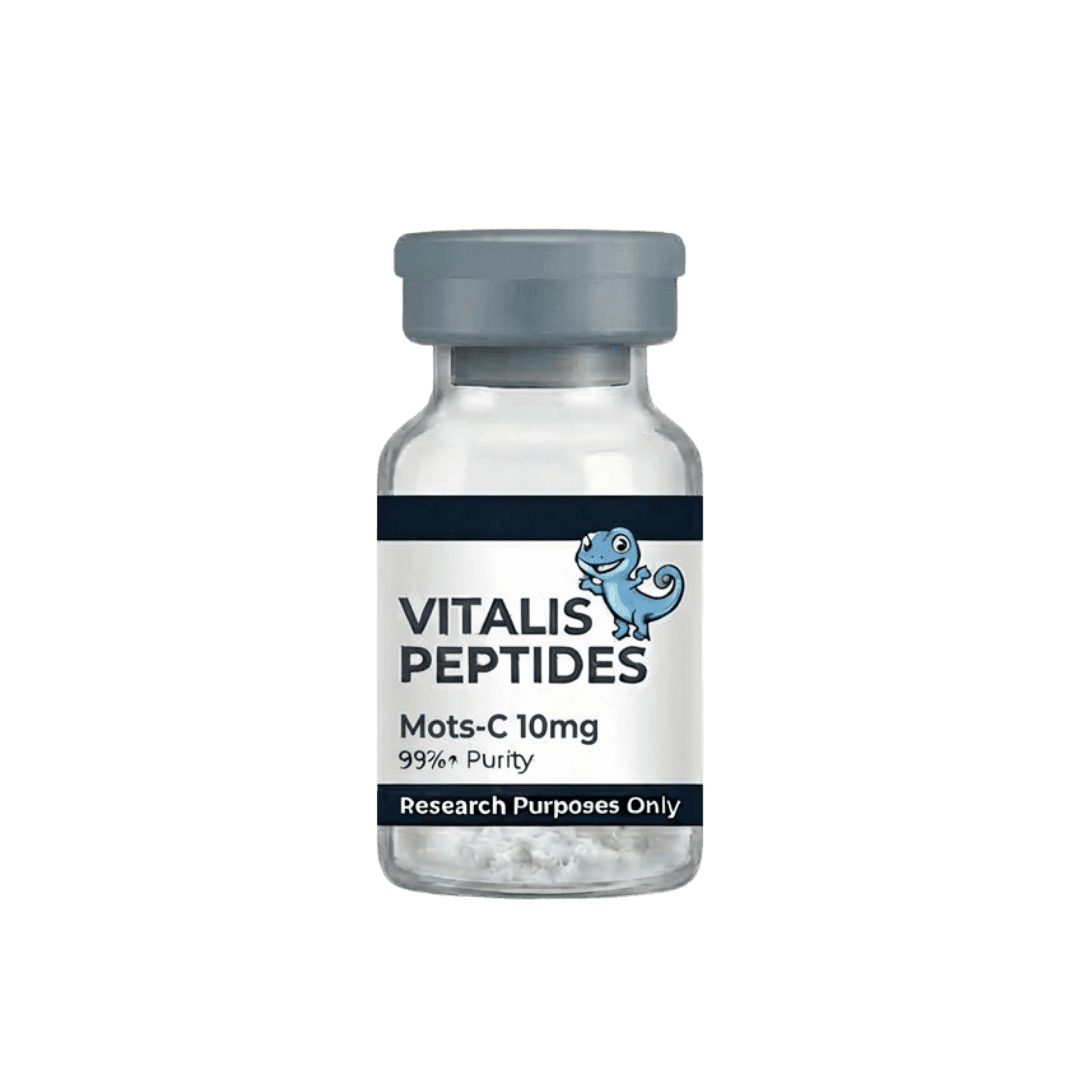
MOTS-C (Mitochondrial Open Reading Frame of the 12S rRNA Type-C) is a 16-amino acid peptide encoded by the mitochondrial genome. Discovered in 2015 by the Lee laboratory at USC, it represents a novel class of mitochondria-derived peptides (MDPs) studied for their roles in metabolic homeostasis, insulin sensitivity, and cellular energy regulation.
MOTS-C is one of several mitochondria-derived peptides (MDPs) that function as retrograde signalling molecules from the mitochondria to the nucleus and beyond. Its primary studied mechanism involves activation of AMP-activated protein kinase (AMPK), a master regulator of cellular energy homeostasis. MOTS-C appears to activate AMPK by inhibiting the folate-methionine cycle in the de novo purine biosynthesis pathway, leading to accumulation of the AMPK-activating metabolite AICAR (5-aminoimidazole-4-carboxamide ribonucleotide).
AMPK activation by MOTS-C triggers a cascade of metabolic effects: increased glucose uptake via GLUT4 translocation, enhanced fatty acid oxidation, inhibition of gluconeogenesis, and stimulation of mitochondrial biogenesis. In preclinical models, MOTS-C administration has been shown to improve insulin sensitivity in diet-induced obesity and age-related metabolic dysfunction models. The Lee laboratory demonstrated that MOTS-C can translocate to the nucleus under metabolic stress conditions, where it regulates gene expression through interaction with the antioxidant response element (ARE) and NRF2 signalling.
MOTS-C levels have been shown to decline with age in both humans and animal models, leading to interest in its role in ageing research. Circulating MOTS-C levels correlate with metabolic health markers, and exercise has been shown to increase endogenous MOTS-C production — positioning it as a potential molecular link between physical activity and metabolic adaptation.
The mitochondrial-derived peptide MOTS-c promotes metabolic homeostasis and reduces obesity and insulin resistance
Lee C, Zeng J, Drew BG, et al. · Cell Metabolism (2015)
Discovery paper identifying MOTS-C as a mitochondria-derived peptide that regulates metabolic homeostasis through AMPK activation, with demonstration of anti-obesity and insulin-sensitising effects in mice.
DOI: 10.1016/j.cmet.2015.02.009The mitochondrial-encoded peptide MOTS-c translocates to the nucleus to regulate nuclear gene expression in response to metabolic stress
Kim KH, Son JM, Benayoun BA, Lee C. · Cell Metabolism (2018)
Demonstrated that MOTS-C translocates from mitochondria to the nucleus under metabolic stress, where it interacts with ARE motifs to regulate adaptive gene expression — a novel retrograde signalling mechanism.
DOI: 10.1016/j.cmet.2018.06.008MOTS-c is an exercise-induced mitochondrial-encoded regulator of age-dependent physical decline and muscle homeostasis
Reynolds JC, Lai RW, Woodhead JST, et al. · Nature Communications (2021)
Showed that exercise increases endogenous MOTS-C levels and that exogenous MOTS-C improves physical performance in aged mice, positioning MOTS-C as a molecular mediator of exercise-induced metabolic benefits.
DOI: 10.1038/s41467-020-20790-0A pro-diabetogenic mtDNA polymorphism in the mitochondrial-derived peptide, MOTS-c
Zempo H, Kim SJ, Fuku N, et al. · Aging (2021)
Identified a common mitochondrial DNA polymorphism (m.1382A>C) that alters MOTS-C structure and is associated with increased diabetes risk, linking endogenous MOTS-C variation to metabolic disease susceptibility.
DOI: 10.18632/aging.202529Add bacteriostatic water slowly along the vial wall. MOTS-C dissolves readily. Do not shake. Store reconstituted solution refrigerated and protect from light.
Use reconstitution calculatorLyophilised: store at or below 5 °C for up to 12 months. Reconstituted: refrigerate at 2–8 °C and use within 30 days. MOTS-C is a relatively small peptide but should still be protected from repeated freeze-thaw cycles.
MOTS-C is encoded by the mitochondrial genome (specifically the 12S rRNA gene), making it a mitochondria-derived peptide (MDP) rather than a nuclear-encoded peptide. It represents a novel class of retrograde signalling molecules that communicate metabolic status from mitochondria to the nucleus.
MOTS-C inhibits the folate-methionine cycle in the de novo purine biosynthesis pathway, leading to accumulation of AICAR (5-aminoimidazole-4-carboxamide ribonucleotide). AICAR is a well-established endogenous AMPK activator, providing an indirect but potent mechanism for AMPK stimulation.
Yes. Studies have shown that circulating MOTS-C levels decrease with age in both humans and animal models. This decline correlates with age-related metabolic dysfunction. Exercise has been shown to increase endogenous MOTS-C production, which may partly explain the metabolic benefits of physical activity.
Reynolds et al. (Nature Communications, 2021) demonstrated that exercise increases endogenous MOTS-C levels and that exogenous MOTS-C administration improved physical capacity in aged mice. MOTS-C is being studied as a potential molecular link between physical activity and systemic metabolic adaptation.
For research and laboratory purposes only. Not for human use. These statements have not been evaluated by the Therapeutic Goods Administration (TGA). This product is not intended to diagnose, treat, cure, or prevent any disease.